Apple Health.
Through MCP.
Give a compatible AI agent access to selected Apple Health records through HealthSync’s remote MCP connection.
See the setupFor iPhone. Check your AI account and records.
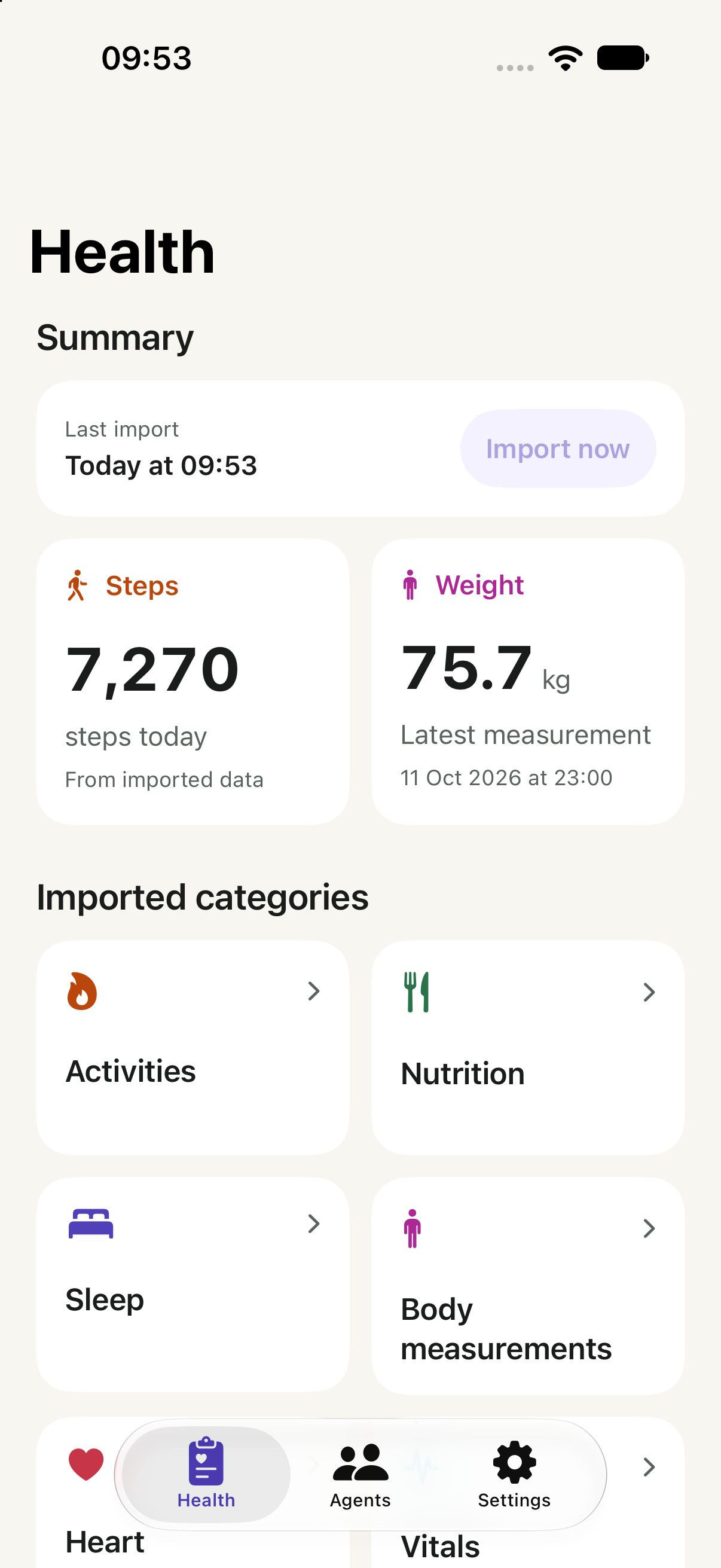
 HealthSync→ Your agent
One library. Your chosen agent.
Selected records.Approved by you.
The bridge is the product.
MCP gives a compatible agent a way to request data. HealthSync supplies the iPhone library, a remote connection, and approval for the records that agent can read.
MCP compatibility alone does not establish that a client supports HealthSync’s authentication and delivery flow. Check the client’s remote-connector support.
Check before
you start.
Confirm your records and your destination before connecting.
Check your MCP client
It must support a remote HTTPS server using Streamable HTTP, OAuth sign-in with automatic client registration, and a browser callback. A local-only MCP client is not sufficient.
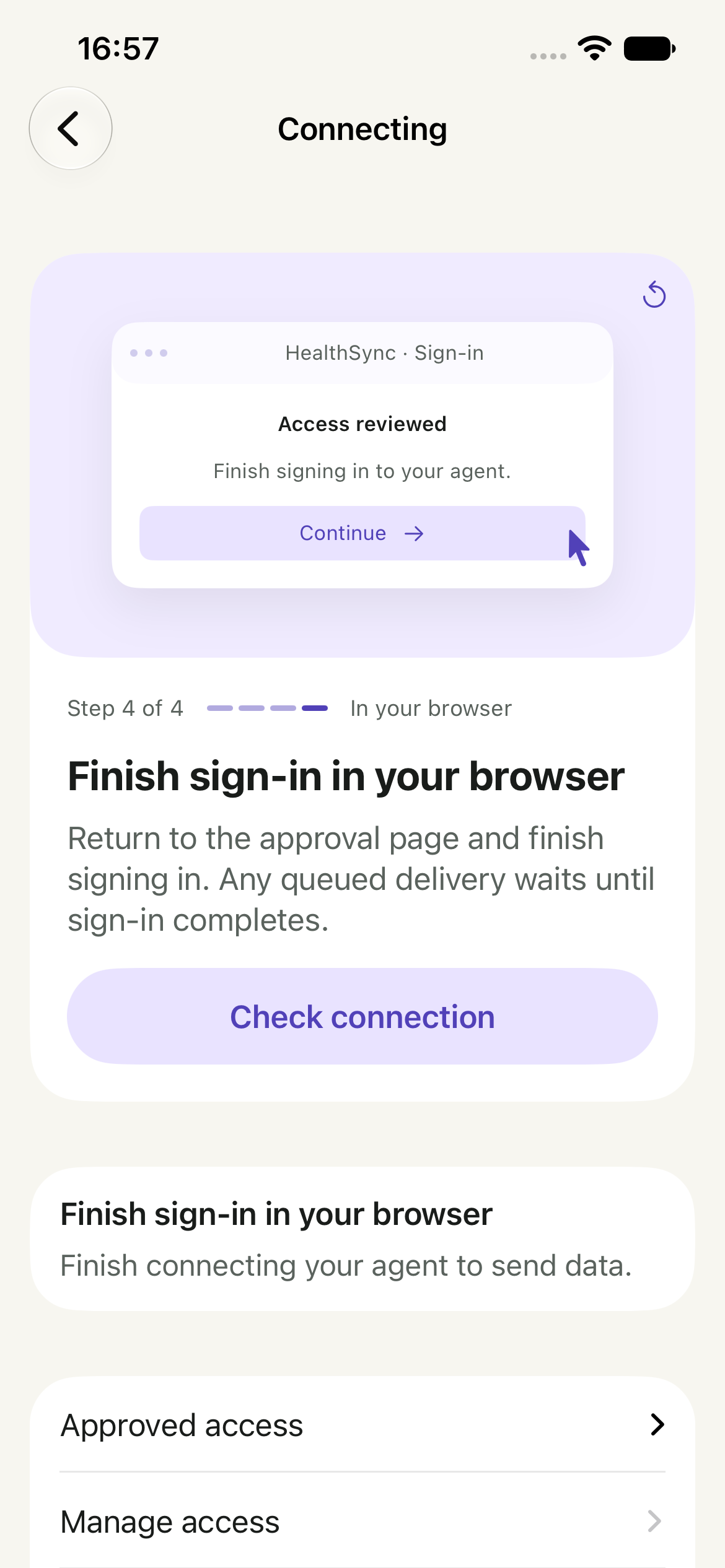
Follow the approval link on your iPhone, then finish sign-in in the original browser. Seeing tools confirms the connection, not delivery of your records.
Using Claude?
Open Customize → Connectors. Look for + Add → Add custom connector. An organisation owner may need to add it first.
Claude documents custom connectors on Free, Pro, Max, Team and Enterprise; Free allows one. Your workspace can restrict access.
Check Claude’s current account and setup requirements ↗
Provider documentation checked 20 October 2026. Account eligibility is separate from a completed HealthSync connection.
Using another AI client?
Check its remote MCP and OAuth support against the client requirements. In HealthSync, open Agents and follow the guide for that provider. Support for MCP alone does not confirm compatibility with HealthSync.
Find records and sources in Apple Health ↗. Depending on iOS, open Search or Browse, then the category and measurement.
Ask with context.
Choose an example to see what context you could share.
Show which categories and dates are available from HealthSync before analysing my data.
Context to share
Available categories and history
Know what
comes through.
Only supported records in Apple Health, within the access you approve.
Available with your permission
- A remote endpoint
- Connect a compatible MCP client at the HealthSync service address.
- Approval on your iPhone
- Review the recipient, health purposes and permitted categories.
- Selected records
- Supported history from your local imported library.
The limits matter
Direct access to HealthKit
The agent connects to HealthSync, not directly to your iPhone’s HealthKit database.
Write access
This connection does not log food or modify another app’s workouts.
From records.
To your AI.
Import your records, connect your AI, then choose when to share.
Build your local library
On your iPhone, sign in with Apple and import the supported Apple Health categories you want to use. Verify that the records are present.
Choose your agent
Open Agents in HealthSync and follow your provider’s guide. In Claude, open Customize → Connectors → + Add → Add custom connector. Enter the address below and use OAuth sign-in.
For Team or Enterprise, an organisation owner may need to add the connector first. Check your account.
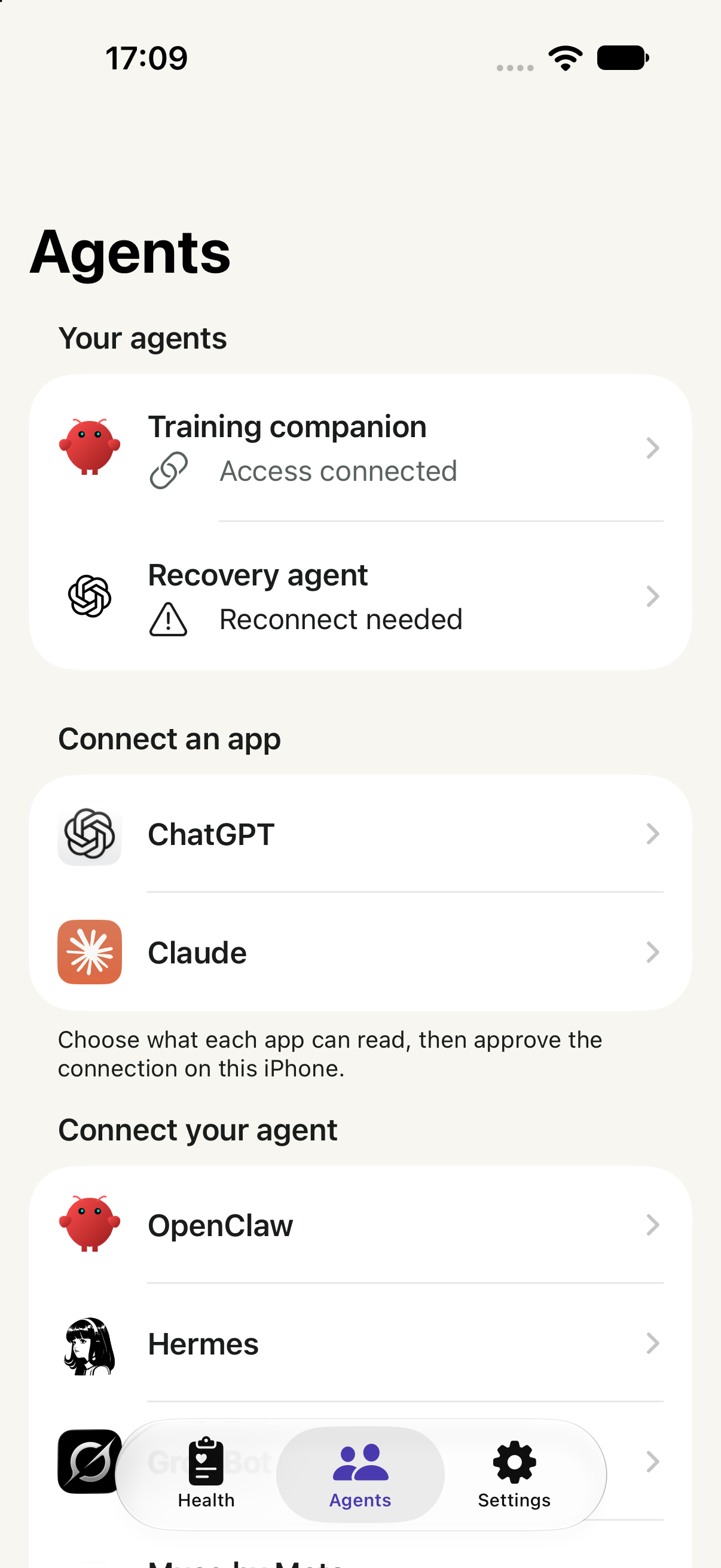
Review access on iPhone
Open HealthSync from the approval page. Review the recipient, purposes and categories. Choose one of the sharing paths below, then return to the original browser to finish sign-in.
Approval, browser sign-in and receipt of your records are separate states.
HealthSync’s remote MCP address
https://api.healthsync.me/mcpChoose when to share
Share now
Choose Connect & share data. This queues a one-time send of your selected records after you finish browser sign-in. Recent data can become ready while older history imports.
Connect first
Choose Connect without sending. After browser sign-in, return to Agents → your connection → Send data in HealthSync when you are ready. Connecting alone sends no records.
When HealthSync shows the data is ready, enable the connector in your AI conversation and ask a question. Only a confirmed receipt means the agent retrieved it. Recurring updates are a separate choice.
Connected, but your agent has no data?
Check that the records exist in your HealthSync library, that this connection can read their categories, and that browser sign-in is complete. If you connected without sending, choose Send data. Follow the connection’s status or retry guidance, then ask the agent to read HealthSync again.
App captures use illustrative data.
Your records.
Your decision.
A library on your iPhone. Access for the agent you approve.
Sending selected records uses HealthSync’s cloud service. Temporary transfer copies are removed after confirmed receipt or expire after seven days. Copies your agent receives follow that provider’s policies.
You can narrow, pause or revoke an agent’s access in HealthSync.
Read the privacy policy ↗Before you connect.
What is MCP?
Model Context Protocol is a way for compatible AI applications to use external tools and data. HealthSync uses it to make your selected health records available to an approved agent.
Do I need to export Apple Health XML?
HealthSync imports supported records through the iPhone app. This workflow does not require a manual export of your entire Apple Health history.
Is the MCP address a secret?
The service address is public. Access to your records requires authentication and your approval. Do not share credentials or approval codes.
Does connecting turn on recurring updates?
No. A one-time Connect & share data instruction is separate from recurring updates. You can also connect without sending.